

Parking Reform Basics


When you think about housing, you might not think about the parking spaces for cars that come along with it. However, these two go hand in hand, and some cities enforce strict parking minimums when creating a new development. Seeing as these strict requirements aren’t meeting the needs of the residents, cities are beginning to introduce parking reforms for their development codes. Parking reform are policies that are implemented at the city level to make it easier for new developments to build more infrastructure and less parking. To achieve this, cities propose updates to their development codes that set lower parking minimums for new projects. Parking reform is gaining traction within the U.S. because cities are finding that a majority of their centers and residential areas are taken up by parking lots. Reducing strict parking minimums means more homes and businesses can be built.
Major North Texas Cities and Their Parking Statistics
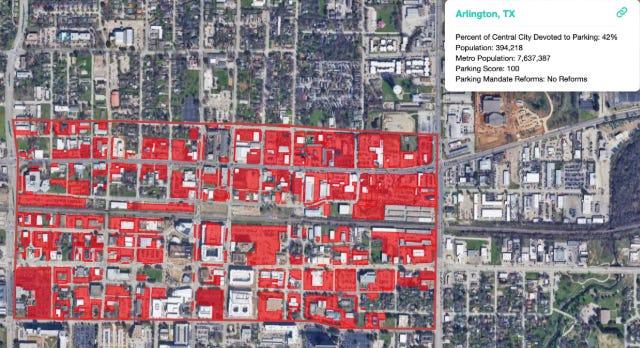
Arlington
Arlington adopted reforms to their parking requirements for commercial, residential, and multi-family land uses. Specifically for mixed-use developments, parking minimums are reduced to ⅓ the amount of parking required in other zoning districts. On July 23, 2025, Arlington City Council approved 7-0 changes to the development code, particularly regarding commercial and multifamily developments. These updates focus mainly on SB 840 and complying with these recommendations. The update allows residential development in any zoning; it also shifts parking minimums to residential builds rather than commercial (even if the development is in a commercially zoned area).
Dallas
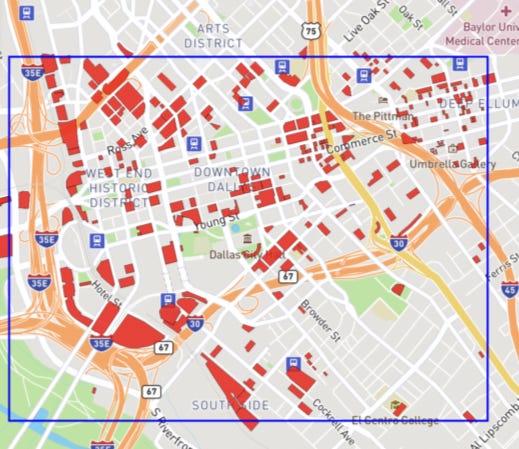
Nearly a quarter of Dallas’ downtown consists of parking lots. Parking for visitors and residents to park before using the amenities downtown has to offer. What happens when these parking lots outnumber the amenities available for those who visit? Dallas is battling with this issue
Not all parking minimums come from businesses; 95% of residential land in Dallas has a parking minimum requirement.
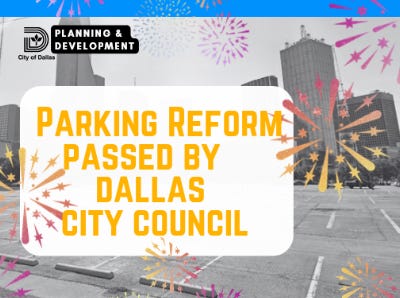
Effective May 14, 2025, Dallas City Council approved the Parking Reform Development Code Amendment
These amendments make the new requirements for single-family housing have a minimum of 1 parking space per dwelling unit for specifically zoned areas (R,D,TH), while all other zoning requires no parking minimum. For transit-oriented development projects, no parking minimums are required within ½ mile of a rail station. This ease in requirements means more space can be used for housing or retail rather than required parking spaces. Residential developments won’t need to meet any parking minimums except for projects over 200 units (requiring one space per unit). Dallas’ parking reform will provide residents and visitors with more amenities, housing, and public spaces. These areas that were once parking lots can be reimagined into spaces that meet the needs of its residents.
To learn about specific actions in the parking reform, click here!
Fort Worth
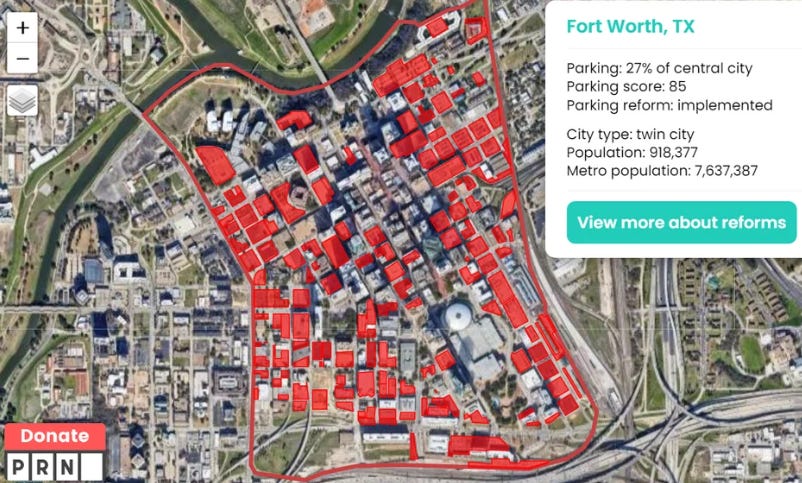
Around 71% of residential land within Fort Worth has a parking minimum requirement that developers and homeowners must follow. These restrictive policies have led to over 27% of Fort Worth’s downtown becoming parking lots, roughly similar to Dallas’s downtown parking percentage.
The Future of Parking Reform
As parking reform gains more traction in the U.S., Texas will most likely see an increase in parking reform across its cities. Major cities within Texas, Dallas and Austin, are already implementing parking reform into their development code and priorities. Updating parking requirements will allow cities to meet the demands of growing cities and the needs of residents. More spaces for homes and businesses will provide more for cities than the vacant parking lot could.
Read our Substack about Austin and Dallas’s parking reform!
Written by Lauren Castilleja
Edited by TFH Team