

At a Glance: Many Black-owned properties and businesses surrounding Fair Park were seized through eminent domain and replaced with parking lots, and more than 75% of the park’s grounds are still impervious surfaces, mostly parking. The same mentality continued for years in Dallas zoning laws, in which developers had to build parking before they could build homes. Dallas approved the reduction or elimination of most parking minimums in May 2025 in a 14-1 vote.
The question remains: What does this mean for South Dallas?
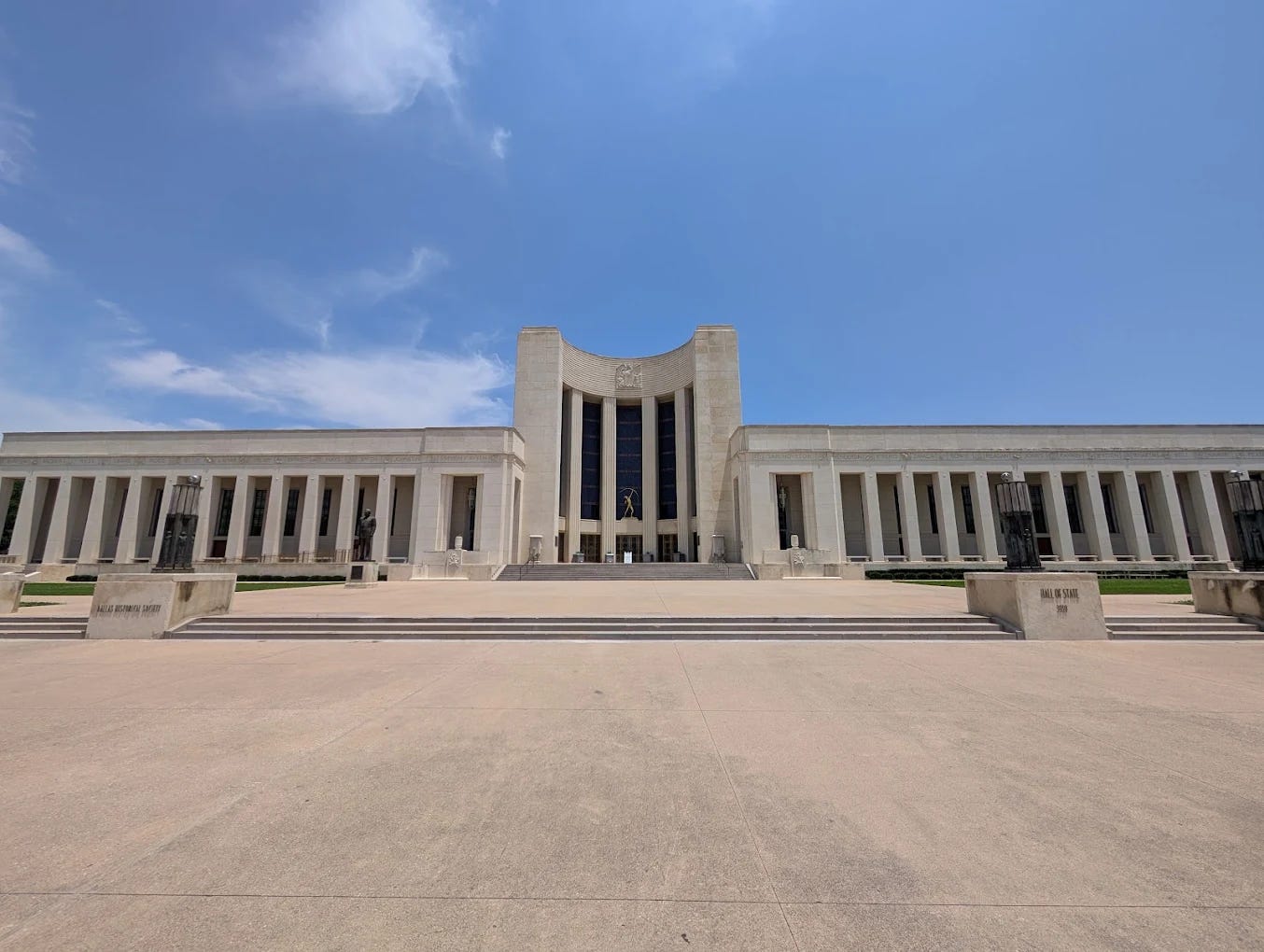
Fair Park is among the most cherished places in Dallas. The 277-acre site hosted the Texas Centennial in 1936, holds one of the largest collections of Art Deco architecture in the United States, and is home to the Cotton Bowl and the State Fair of Texas. It also shows what happens when a city cares more about cars than communities.
A Neighborhood Traded for Parking
Fair Park is located in a predominantly Black community in South Dallas, one that the city treated as an inconvenience for many decades. Black residents were allowed at the fair on only one day, known as Negro Achievement Day. The Hall of Negro Life, built for the Centennial celebration, was the only Centennial building demolished, just a year after it opened.
There was more to come. In the 1960s and 1970s, hundreds of Black-owned homes and businesses around the park were taken through eminent domain and turned into parking lots to serve the growing State Fair. According to NBC DFW, about 600 homes once stood where the parking lots are now. A report by the Foundation for Community Empowerment found that from 1970 to 2013, housing units citywide increased by 72%, while housing in the area around Fair Park dropped by more than 50%. Civil rights activist Peter Johnson took up the cause of those being forced from their homes, but the clearing went ahead anyway. This was a real community. Lucy Cain, who grew up in the neighborhood, said it remained a community even during segregation.
The Open Lots in Fair Park...Car Lots
The park’s operators describe more than 75% of the grounds as impervious surfaces, mostly parking, which earned the park the nickname “Fair Parking.” The State Fair also owns several other parcels in and around South Dallas that it says it needs for fair parking. Wilonsky’s reporting describes an aerial photograph of the neighborhood on a Texas-OU morning that looked like tens of thousands of Matchbox cars. The fair runs for 24 days a year, but the pavement is there all year. Reports describe the eastern parking lots as used only 24 days a year.
A Goal with Two Different Paths
While Fair Park is a specific place, parking regulations are broad. Fair Park involved bulldozing existing homes in one specific location. Parking requirements raise costs and add hurdles without tearing down any homes.
For decades, developers in Dallas, Fort Worth, and other major Texas cities usually could not build homes or apartments without including parking. In Dallas, that meant one parking space for every bedroom in an apartment. The city puts it plainly: these requirements prevent much-needed housing from being built and turn valuable land into empty parking lots.
So What Changed?
After nearly six years of work, the Dallas City Council voted 14-1 to reduce or eliminate parking minimums on May 14, 2025. According to the city summary, multifamily buildings with 20 or fewer units have no minimum. Buildings with 21 to 199 units must provide half a space per unit, and buildings with 200 or more units must provide one space per unit. There are other exemptions: no minimum applies to developments in the Mixed Income Housing Density Bonus program, to most office and retail uses, to historic buildings, or to developments near a light rail station or downtown. In many zoning districts, single-family homes still need one parking space per unit.
The rules apply across the city’s development code, including planned development districts where applicable. In practice, the effect on any one property will depend on the requirements attached to it.
There were genuine concerns about spillover parking. Council Member Cara Mendelsohn, the only dissenting vote, said the policy did not meet the needs of Far North Dallas. Council Member Carolyn King Arnold supported the reform but urged staff to do more outreach in southern Dallas.
This Could Go South for South Dallas
Reform does not undo what happened, and it will not produce affordable housing on its own. It removes only one roadblock. Financing, land prices, infrastructure, and other zoning rules still matter.
Here is what to watch:
Between 1970 and 2013, the neighborhood surrounding Fair Park lost more than half of its housing units. Now an apartment building no longer has to provide mandated parking before it can be built on the vacant land that remains in the area.
The park itself is already changing. On August 12, 2026, the City Council approved a tax increment financing agreement for the roughly 10.5-acre Community Park at Fair Park. It will be built on a parking lot on the east side of the grounds, with an opening scheduled for 2028. In addition, Parks and Recreation staff have outlined a plan to develop other eastern parcels with hotels, retail, and entertainment venues.
Questions remain. Parking reform does not decide whether any of this land adds to the housing supply, or who gets to live there. And the State Fair’s other parcels sit outside the park and outside the scope of that planning.
A Different Dallas
Dallas cannot return the homes that were razed for the Fair Park parking lots, but it can stop repeating the same planning logic. Parking reform alone will not solve South Dallas’s housing challenges, but it gives the city a chance to make a different choice: let land serve the people who live there, rather than require every new home to make room for a car.
Written by Taylor Walker Thornton
Edited by TFH Team